
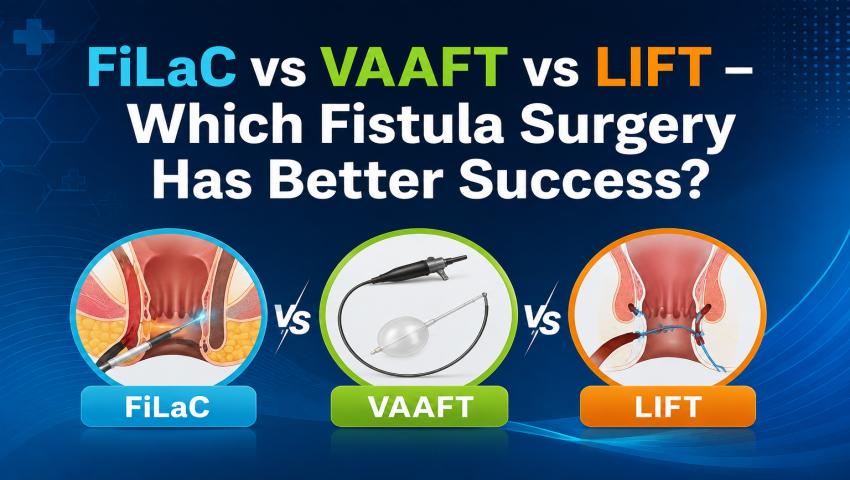
If you have been told that you have an anal fistula, you are probably searching for the best treatment option. There are many surgeries available today. FiLaC, VAAFT, and LIFT are three of the most talked-about ones. All three try to do the same thing, close the fistula tract, without damaging the sphincter muscle. But each works in a different way, and each suits different kinds of fistula.
This blog is written with guidance from Dr. Samrat Jankar, Director, Consultant Surgical Gastroenterologist & Colorectal Surgeon at Kaizen Gastro Care, and a leading fistula specialist in Pune with over 17+ years of surgical experience. He has performed more than 5,000+ fistula surgeries and is known for his ethical, patient-focused approach to complex fistula care. If you are looking for a fistula surgeon who can explain your options clearly, this comparison will help you make an informed decision.
What Is an Anal Fistula?
An anal fistula is an abnormal tunnel. It forms between the inside of the anal canal and the skin on the outside, near the anus. Most fistulas develop after an anal abscess bursts or gets drained. Once the abscess heals partially, a small track is often left behind. This track keeps discharging pus or fluid on and off. Since the tunnel has an opening on both ends, it rarely closes on its own. That is why surgery becomes necessary in almost all cases.
Common Causes of Anal Fistula:
- An anal abscess that was drained but not fully treated
- Crohn’s disease or other inflammatory bowel diseases
- Tuberculosis, though this cause is uncommon in India today compared to earlier decades
- A history of previous anal or rectal surgery
- Diabetes, weak immunity, or long-standing constipation, all of which slow down healing
Signs and Symptoms You Should Not Ignore:
Many patients try home remedies first and visit a doctor only when the problem becomes severe. This delay often turns a simple fistula into a complex one. Please do not ignore these signs:
- Constant or throbbing pain near the anus, especially while sitting or passing stool
- Pus, blood, or foul-smelling discharge that stains your underwear
- Swelling that appears, settles down, and then comes back again
- Recurring fever, which usually means a fresh abscess is forming
- Itching, irritation, or skin soreness around the fistula opening
If any of these sound familiar, please consult a proctologist soon. The longer you wait, the more branches the tract can develop, which makes treatment more difficult later.
What Is FiLaC Surgery?
FiLaC stands for Fistula Laser Closure. This is a relatively newer, laser-based technique that has become popular in the last decade because it protects the sphincter completely.
How FiLaC Works?
A thin laser fibre is passed through the external opening, all the way along the fistula tract. As the fibre is slowly withdrawn, laser energy heats the inner lining of the tract. This heat causes the tract walls to shrink and seal together from the inside. No cutting of muscle is involved at any stage, which is why FiLaC is classified as true sphincter-saving surgery.
Benefits of FiLaC Surgery:
- Full muscle control is preserved, so there is almost no risk to continence
- Pain after surgery is much less compared to open procedures
- Many patients go home the same day, making it a good day-care fistula surgery option
- Works reasonably well even in cases needing complex fistula management
Limitations of FiLaC:
- Results are less predictable in very high anal fistula, where the tract runs deep
- The equipment and disposable fibres make this option a bit costlier than traditional surgery
- Success depends heavily on the length of the tract and how many branches it has
What Is VAAFT Surgery?
VAAFT stands for Video-Assisted Anal Fistula Treatment. Instead of working blindly through the tract, the surgeon actually sees inside it using a tiny camera called a fistuloscope.
How VAAFT Treats an Anal Fistula?
The fistuloscope is inserted through the external opening and guided along the tract. The surgeon watches the entire pathway on a screen in real time. This makes it possible to locate the internal opening precisely and close it properly. The inner lining of the tract is also cleaned and cauterised under direct vision, something that is very difficult to achieve without a camera.
Benefits of VAAFT Surgery:
- Sphincter muscle is fully protected throughout the procedure
- Internal opening closure is far more accurate compared to blind techniques
- Particularly useful for a recurrent anal fistula, where old scar tissue can hide the original tract
- Very little external cutting, so scarring is minimal
Possible Drawbacks:
- Requires specialised equipment and a surgeon trained specifically in this technique
- The procedure usually takes a bit longer than simpler surgeries
- Very short or very superficial tracts may not need this level of intervention at all
What Is LIFT Surgery?
LIFT stands for Ligation of Intersphincteric Fistula Tract. Unlike FiLaC and VAAFT, this is a more established, time-tested technique that has been used successfully for many years.
How the LIFT Procedure Is Done?
The surgeon makes a small incision in the space between the internal and external sphincter muscles, exactly where the fistula tract passes through. The tract is identified in this intersphincteric space, tied off with sutures, and then divided. Both the internal opening and the tract are closed without disturbing the sphincter fibres on either side.
Benefits of LIFT Surgery:
- Strong, well-documented success rate in simple to moderately complex fistulas
- Fecal continence is very well preserved, since the muscle is simply parted, not cut
- Lower chances of recurrence when the case is chosen correctly
Limitations of LIFT:
- Less reliable when the tract is very complex, branched, or has multiple openings
- Careful case selection is essential; not every fistula is suitable
- Complete healing can take a few weeks longer compared to laser-based options
FiLaC vs VAAFT vs LIFT: Key Differences
Which Surgery Has the Better Success Rate?
There is no single winner among the three. Each technique performs differently based on how the fistula is structured.
- FiLaC Success Rate: FiLaC generally works well in simple and moderately complex tracts. When the tract is short and straight, laser closure heals nicely. Longer or heavily branched tracts are harder to seal completely with laser alone.
- VAAFT Success Rate: Because the surgeon can actually see the tract and internal opening on screen, VAAFT tends to give more precise closure. This visual guidance is especially helpful in tricky, recurrent, or previously operated cases.
- LIFT Success Rate: LIFT remains a dependable option, particularly for straightforward intersphincteric fistulas. Decades of use have proven its reliability when the right patient is chosen.
Instead of chasing a single “best” number, what actually matters is matching the correct procedure to your specific fistula. A good surgeon studies the MRI, understands the tract’s path, and then decides which technique will heal best in your case.
Factors That Affect Treatment Success:
- Accurate MRI fistula mapping before surgery, so the surgeon knows the exact path and branches
- Length, depth, and complexity of the tract
- How many times the fistula has been operated before
- General health factors like diabetes, smoking, and immunity
- The surgeon’s hands-on experience in advanced proctology treatment techniques
Which Surgery Is Best for Different Types of Fistula?
Not every fistula is the same. The tract can be short or long, straight or branched, close to the skin or deep near the muscle. This is exactly why doctors do not use one surgery for all patients. Let us understand which option usually works best for each type.
- Simple Anal Fistula: A simple fistula has a short, straight tract. It does not involve much of the sphincter muscle. In such cases, a basic fistulotomy or LIFT usually gives excellent results. Both procedures are quick, healing is fast, and the chances of recurrence are low. Since the tract is not complicated, there is no real need for costlier laser or camera-based techniques here.
- Complex Anal Fistula: A complex fistula has more than one tract, or it passes through a larger portion of the sphincter muscle. In such tricky cases, cutting the muscle directly can be risky, as it may affect bowel control later. This is where VAAFT or FiLaC work better. Both these techniques are suited for complex fistula management because they treat the tract without touching the muscle. VAAFT lets the surgeon see every branch clearly with the camera, while FiLaC seals the tunnel gently using laser heat. Either option can reach deeper tracts safely, something a basic surgery cannot always do.
- Recurrent Anal Fistula: Sometimes a fistula comes back even after surgery. This happens when a tiny branch was missed earlier, or scar tissue hides the real path. Operating on a recurrent anal fistula is harder, since old scarring makes the tract difficult to locate. VAAFT often has an edge here, because the camera can travel through the old scar tissue and show the exact path on screen. FiLaC can also work well in many recurrent cases, depending on how the tract is shaped after the previous surgery. The doctor usually decides based on the MRI report and the details of the earlier operation.
- High Anal Fistula: A high anal fistula runs deep, close to important muscle fibres that control bowel movement. Treating this type needs extra caution, because any damage to these muscles can lead to poor control later. High anal fistula treatment is never a quick decision. The surgeon studies the MRI carefully first, understands exactly how high and how deep the tract goes, and only then chooses the right approach. Depending on the findings, this could be LIFT, FiLaC, or sometimes even a staged, combination approach, where the treatment is done in more than one sitting for better safety and healing.
Recovery Tips After Fistula Surgery:
Recovery after fistula surgery is usually smooth, but a lot depends on how well you take care of yourself at home. Following these simple steps can make healing faster and more comfortable.
1. Diet to Follow:
- Include fibre-rich foods such as fruits, vegetables, whole grains, and salads in your daily meals.
- Drink enough water throughout the day to keep your stools soft.
- Add foods like papaya, oats, and leafy vegetables, as these help prevent constipation naturally.
- Avoid oily, spicy, and fried food for at least a few weeks, since straining during bowel movements can affect healing.
- Cut down on tea, coffee, and carbonated drinks, as these can sometimes cause constipation.
- If needed, your doctor may suggest a mild stool softener to make bowel movements easier during the healing phase.
2. Hygiene Tips:
- Keep the operated area clean and completely dry between washes.
- Warm water sitz baths, done two to three times a day, help reduce swelling and speed up healing.
- Use plain water or a mild antiseptic solution as advised by your doctor. Avoid harsh soaps near the wound.
- Wear loose, breathable cotton underwear, as tight clothing can irritate the area.
- Change your dressing regularly, as per your surgeon’s instructions.
- Always dry the area gently with a clean, soft towel instead of rubbing.
3. Activity Restrictions:
- Avoid heavy lifting, cycling, or long hours of sitting for the first couple of weeks.
- Gentle walking is actually encouraged, as it improves blood flow to the healing area.
- Avoid strenuous exercise, gym workouts, or swimming until your doctor gives the go-ahead.
- Try not to sit on hard surfaces for too long, a soft cushion can ease the pressure.
- Avoid straining while passing stools, as this can affect the healing wound.
- Resume work only once your doctor confirms that healing is progressing well.
4. Follow-Up Care:
- Do not skip your follow-up visits. Regular check-ups help your doctor track postoperative wound healing closely.
- Keep your doctor informed about any new symptoms, however small they seem.
- Follow the medicine schedule properly, do not stop antibiotics or painkillers on your own.
- Ask your doctor when it is safe to resume normal diet, travel, or physical activity.
- Keep your MRI reports and discharge summary safe, as they help in future consultations if needed.
Risks and Possible Complications:
Like any surgery, fistula treatment also carries a few risks. Most of these are manageable if detected early, which is why awareness matters.
- Infection: This is uncommon when hygiene instructions are followed properly. However, any sudden increase in pain, redness, swelling, or discharge should be reported to your doctor immediately.
- Recurrence: Can happen if a hidden branch of the tract is missed during surgery, or if healing does not complete fully. This is why choosing an experienced surgeon and following an accurate MRI fistula mapping matters so much.
- Delayed Healing: Diabetes, smoking, and poor nutrition are known to slow down recovery in fistula patients. Keeping blood sugar under control before and after surgery really helps.
- Rare Side Effects: Occasionally, patients notice minor bleeding or temporary discomfort at the wound site. This usually settles within a few days without any extra treatment.
- Difficulty in Passing Stools: Some patients feel mild discomfort or hesitation while passing stools in the first few days. This is normal and usually improves with a soft diet and proper hydration.
- Minor Changes in Bowel Control: In rare cases, patients may notice slight difficulty in controlling gas or stools soon after surgery. This is usually temporary and settles once the muscles heal fully, especially with sphincter-saving techniques like FiLaC, VAAFT, and LIFT.
- Skin Irritation Around the Wound: Constant moisture or discharge in the early days can sometimes cause mild skin irritation near the operated area. Keeping the area clean and dry usually resolves this quickly.
How Does a Doctor Choose the Right Surgery?
- Fistula Type and Location: Whether the tract is simple, complex, low, or high changes the entire treatment plan. This is why MRI mapping is so important before any decision is made.
- Patient’s Health Condition: Age, diabetes, immunity, and even lifestyle habits like smoking are all taken into account before finalising the approach.
- Previous Fistula Surgeries: If you have already undergone one or more surgeries, the doctor needs to study the earlier operative notes and plan more carefully for fistula recurrence prevention.
A skilled colorectal surgeon never applies a one-size-fits-all approach. Every MRI report and every patient history is reviewed in detail before recommending FiLaC, VAAFT, LIFT, or any other technique.
Frequently Asked Questions (FAQs):
Not exactly “better” in every case. Both are effective, sphincter-saving procedures. The right choice depends on your tract’s length, complexity, and whether it is a first-time or recurrent fistula.
Yes, when the case is selected correctly and the surgery is performed well, LIFT gives long-lasting results with a low chance of recurrence.
FiLaC generally allows the quickest return to daily activities, since it can often be done as day-care fistula surgery with minimal downtime.
Yes, recurrence is possible with any surgical technique. However, choosing the right procedure, along with an experienced surgeon, significantly reduces this risk.
Modern minimally invasive procedures like FiLaC, VAAFT, and LIFT cause much less pain compared to traditional open surgery. Most patients manage comfortably with simple oral painkillers.
Most patients return to their normal routine within two to four weeks, depending on which procedure was done and how well they follow post-surgery care instructions.
Conclusion:
FiLaC, VAAFT, and LIFT are all effective, sphincter-saving options for fistula treatment. The right choice depends on your fistula type, health, and surgical history. For trusted FiLaC procedure treatment , VAAFT procedure treatment, and LIFT procedure treatment in Pune, visit Kaizen Fistula Care.
Under the expert guidance of Dr. Samrat Jankar, patients receive personalised, ethical, and result-driven care. With 5,000+ fistula surgeries performed, Dr. Samrat Jankar is among the most trusted names for fistula treatment in Pune.
Book your consultation today and take the first step towards lasting relief.


Recent News

Chronic Anal Fissure: When Does It
18th September 2026
The Sandwich Approach: Combining Biofeedback and
11th September 2026
Persistent Pus Discharge Near the Anus
28th August 2026
FiLaC vs VAAFT vs LIFT –
10th August 2026
How Surgeons Map Fistula Tracts Before
5th August 2026
Multiple External Openings in Fistula: What
16th July 2026
Why Choosing the Right Fistula Surgeon
15th July 2026
Why Is Seton Placement Used in
30th June 2026
Can Diabetes Delay Fistula Healing?
26th June 2026
Can Laser Surgery Treat All Types
19th June 2026Location
Contact info
- Kaizen Gastro Care, Shop no. 208 / 209, Oriana Crest building, Datta mandir road, Opposite Costa Rica society, Wakad, Pune - 411057
- gastrosamrat@gmail.com
- 097636 35252 / 079041 39064
Fistula Cure
Quick links
© 2026 Kaizen Fistula Care All rights reserved | Website Designed by Digital Mogli LLP