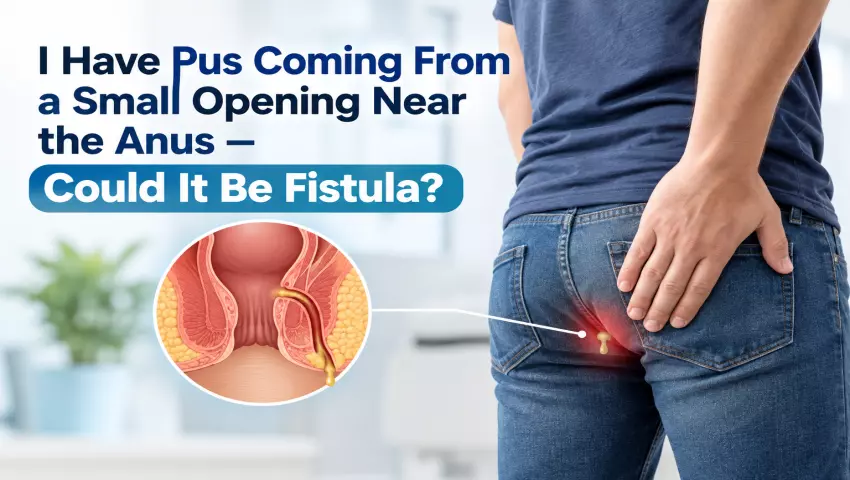
Do you see pus coming from the anus or from a spot near it? Many people feel scared and shy about this. So they wait for weeks. Please do not wait. A small hole near the anus that keeps leaking is often an anal fistula. The good news is that it can be treated. At Kaizen Fistula Care, Dr. Samrat Jankar, an experienced colorectal surgeon with 17+ years of practice, has done over 5,000 fistula surgeries. In this blog, he explains the signs, causes, tests and treatment in simple words.
Pus means there is an infection. Germs collect in a small gland inside the anus. The gland gets blocked. A pocket of pus forms. This is called a perianal abscess. When it bursts, pus comes out through the skin. If the pus keeps coming, a small tunnel may form. This tunnel is a fistula.
Yes, it can be. Pus discharge near the anus that comes again and again is a common sign. It is more likely if you had a painful boil or abscess near the anus before. But not every discharge is a fistula. Piles and skin infections can look similar. Only a colorectal surgeon can tell you for sure.
An anal fistula is a small tunnel. It joins the inside of the anus to the skin outside. Doctors also call it a perianal fistula. It usually starts after an anal abscess. The abscess drains, but the tunnel stays open. Stool and germs keep going inside. So the infection comes back again and again.
A small opening near the anus usually forms after an infection. It is most often a sign of an anal fistula. Here are the common causes:
Sometimes, no clear cause is found. This is not your fault.
Any small hole near the anus that leaks pus should be checked by a colorectal surgeon.
These are the common fistula-in-ano symptoms:
Anal fistula discharge colour is usually yellow, white or brown. Sometimes there is blood too. A small hole near the anus leaking fluid is a warning sign. Some people have pus without pain near the anus. Even then, please get it checked.
Here is the difference between perianal abscess and fistula. An abscess is a sudden pocket of pus. It causes severe pain, swelling and fever. A fistula is the long-term tunnel that may follow. It gives less pain but constant discharge. So, the abscess is the early stage. The fistula is the later stage.
The table below shows the main differences at a glance:
If you have pus discharge near the anus, please get it checked early.
The tunnel stays connected to the anus. Germs and stool keep entering it. The body cannot clear the infection. So you get continuous pus drainage from the perianal wound. The hole may close for a few days and then open again. This is recurrent pus near the anus. Many patients ask, “Why does my fistula discharge smell bad?” The reason is germs and small traces of stool inside the tunnel.
Pus near the anus is never normal. Please do not wait for it to go away on its own. Early check-up means simpler treatment and faster recovery.
See a doctor if:
See a doctor immediately if you have:
If you have diabetes, Crohn’s disease or low immunity, do not delay. Infection can spread faster in these cases. A colorectal surgeon can examine you and tell if it is a fistula. Creams and home remedies cannot cure it.
Diagnosis is usually simple. The doctor first asks about your symptoms and past history, such as an earlier abscess, diabetes or Crohn’s disease. Then he gently examines the area around the anus. He checks the small hole, the skin and the path of the tunnel.
The main aim is to find the inner opening inside the anus. The doctor also checks how close the tunnel is to the anal muscles. This helps him plan a safe treatment that protects your bowel control.
Not every hole near the anus is a fistula. So, a proper check-up by a colorectal surgeon is important.
Simple fistulas may not need any test. Complex or repeat cases need scans. Common tests are:
No medicine or cream can close a fistula. The tunnel is lined with tissue, so it does not heal on its own. It needs surgery. The right surgery depends on where the tunnel is, how deep it goes and how much muscle it crosses. Your general health also matters.
There is no single best surgery for everyone. The surgeon first finds the inner opening and checks the path of the tunnel. Then he chooses the safest method. A good choice lowers the chance of the fistula coming back and protects your bowel control.
Very rarely. The tunnel has its own lining. So germs keep entering it. The hole may look closed for some time. But the infection stays inside. Then the pus comes back. If you wait too long, new tunnels may form. Then the surgery becomes harder. So it is better to treat it early.
Many people ask how to stop pus coming from a fistula at home. Home care cannot cure it. But it can give you some relief until treatment:
Please see a doctor soon, even if the discharge reduces.
Yes, it often is. Pus that comes again and again from a small opening is a common sign of an anal fistula. This is more likely if you had a painful boil or abscess near the anus earlier. Other problems can look similar, so a specialist should confirm it.
It usually means there is an infected tunnel between the anus and the skin. The pus drains out through this small hole. Sometimes it can also be a draining abscess. A proper check-up will tell you which one it is.
No, a true fistula does not heal fully without surgery. The hole may close for a few days, but the infection stays inside. Then the pus comes back. Medicines and home care can only give temporary relief.
An abscess is a sudden, painful pocket of pus. It causes swelling and often fever. A fistula is the long-term tunnel that may form after the abscess drains. It gives less pain but keeps leaking pus.
Both are possible. Many people have only mild pain or no pain at all. Pain increases when the hole gets blocked and pus is trapped inside. Even a painless discharge needs a check-up.
The doctor asks about your symptoms and examines the area gently. He looks for the outer hole and the inner opening. In complex or repeat cases, an MRI or ultrasound is also done. This shows the exact path of the tunnel.
The options are fistulotomy, seton placement, the LIFT procedure, laser treatment and rectal advancement flap repair. The right one depends on the position of the tunnel and its closeness to the anal muscles. The surgeon chooses what is safest for you.
See a doctor if the discharge lasts more than a week or keeps coming back. Also go if you have a painful lump, fever or increasing swelling. Early treatment means simpler surgery and faster recovery.
Pus near the anus is never normal. A small hole near the anus that keeps leaking is often an anal fistula. It does not go away on its own. Creams and home remedies can only give temporary relief.
Please do not feel shy or wait for weeks. Early treatment means simpler surgery, faster recovery and a lower chance of the problem coming back. Today, safe options like laser treatment, LIFT, seton and PILTEC are available. These protect your anal muscles and bowel control.
Don’t ignore the symptomsβbook your appointment today to get your condition assessed and discuss the most suitable treatment for you. Early consultation can help you understand your options and take the next step towards recovery.
Β© 2026 Kaizen Fistula Care All rights reserved | Website Designed by Digital Mogli LLP