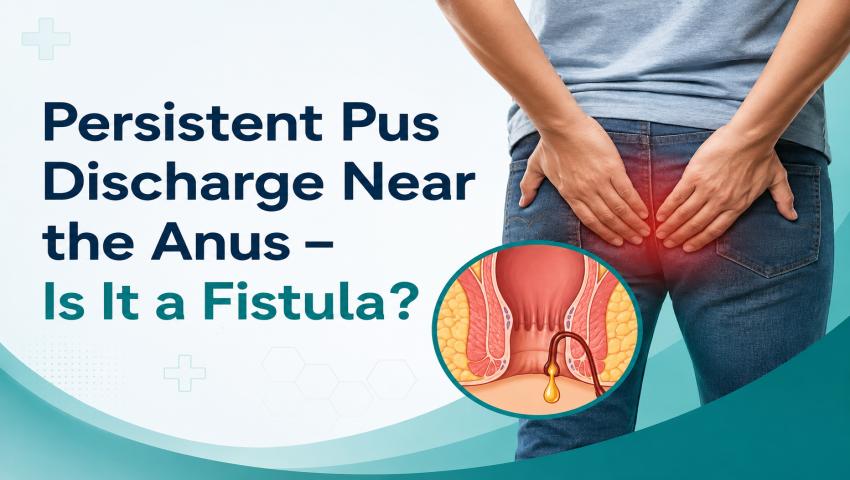
Many people notice pus discharge near the anus and feel embarrassed to talk about it. They wait, hoping it will heal on its own. Some even avoid seeing a doctor for months, out of shame or fear. But this delay often makes the problem worse over time.
Persistent discharge near the anus is often a sign of an anal fistula. This is a condition that rarely heals without proper treatment. The longer it is ignored, the more complex it can become.
At Kaizen Fistula Care, Dr. Samrat Jankar, a Fistula Specialist in Pune, has helped thousands of patients get lasting relief from this exact problem. With 17+ years of experience and 5,000+ fistula surgeries behind him, he has seen almost every kind of case walk through his door. In this blog, he explains why pus discharge happens, how to know if it is a fistula, and what treatment options actually work.
Pus discharge from anus usually happens due to infection. Inside the anal canal, there are small glands. These glands help in easy passage of stool. Sometimes, these glands get blocked. Once blocked, bacteria can grow inside them, leading to infection.
This infection causes a collection of pus, known as an anal abscess. An abscess is like a small pocket filled with pus, and it can be quite painful. If this abscess is not treated fully, it does not heal in a normal way. Instead, it forms a small tunnel under the skin.
This tunnel connects the infected gland inside to the skin outside the body. Pus then keeps draining through this tunnel, again and again. This ongoing tunnel is called an anal fistula. It is one of the most common reasons behind long-term, repeated discharge near the anus.
Not always, but it is one of the most common causes. Persistent pus discharge near the anus can also happen due to simple skin infections, small boils, or minor irritation from sweating or friction.
However, there are certain signs that point more strongly towards a fistula. If the discharge continues for weeks without stopping, if it keeps coming back after seeming to heal, or if it is joined by pain and swelling, a fistula is very likely. Only a proper check-up by a specialist can confirm whether it is truly a fistula or something else.
Some common causes of pus and drainage from the anus include:
Understanding the exact cause is important, because treatment differs based on what is actually causing the discharge.
Common anal fistula symptoms include:
Many patients notice these symptoms slowly getting worse over weeks or months. If you notice these signs of anal fistula, even in mild form, it is best to consult a specialist soon rather than waiting.
Some symptoms need urgent medical attention, and delaying a visit to the doctor can be risky. Please do not ignore:
These signs may point to a complex anal fistula, a growing infection, or a fresh abscess forming again. In such cases, please see a specialist as soon as possible, rather than trying home remedies.
Many patients get confused between anal abscess and a fistula, as both involve pus near the anus. But they are different stages of the same problem.
An anal abscess is a sudden, painful collection of pus near the anus. It often comes with fever, swelling, redness, and severe pain that develops quickly, sometimes within a day or two. It usually needs urgent drainage.
An anal fistula, on the other hand, is a small tunnel that forms after an abscess does not heal fully, or after it is drained incompletely. It causes ongoing, low-grade discharge rather than sudden severe pain. The pain with a fistula is usually milder but keeps troubling the patient for a longer time.
In short, an abscess is usually the starting point of the problem. A fistula is often what follows, if the abscess is not treated completely and properly at the right time.
This is a common question that many patients ask, hoping to avoid surgery. Unfortunately, an anal fistula almost never heals completely on its own.
The outer opening of the tunnel may close for a short time. This can give the patient a false sense of relief, making them think the problem is gone. But since the inner opening near the gland is still infected, the tunnel usually reopens after some time. This leads to repeated infection, fresh discharge, and sometimes a new abscess.
Proper medical or surgical treatment is needed to close the fistula tract fully and give lasting relief from this cycle.
A correct diagnosis is very important before starting treatment. It usually involves:
These tests help the doctor understand the full picture. They show whether it is a simple low anal fistula, or a more complex, high anal fistula that involves deeper muscles. This information is very important for planning safe and effective treatment, and for avoiding damage to the muscles that control bowel movements.
Treatment depends on the type, depth, and complexity of the fistula. There is no one-size-fits-all approach. Common options include the following.
Recovery time depends on the type of fistula and the treatment method chosen. Many patients recover within 2 to 4 weeks after laser fistula surgery or the LIFT procedure, with most daily activities resuming much sooner.
Ksharsutra treatment may take longer, since it works gradually over several weeks with regular thread changes. Your doctor will guide you on proper wound care, hygiene, and follow-up visits to ensure the best possible healing and to avoid any setbacks during recovery.
To lower the risk of a recurrent fistula, patients should follow a few simple steps:
Following these steps closely can make a real difference in long-term healing and prevent repeated trouble in the future.
You should see a fistula specialist if you notice pain near the anus, swelling, or any pus or blood discharge that does not stop on its own. Even mild but repeated symptoms deserve proper attention, rather than being brushed aside.
Early consultation with a colorectal surgeon or proctologist prevents the condition from becoming complex or chronic. Simple fistulas are usually easier and quicker to treat than fistulas that have been ignored for a long time.
Dr. Samrat Jankar leads fistula care at Kaizen Fistula Care in Pune, and patients often mention the same things about him: he listens, he explains clearly, and he doesn’t rush into surgery unless it’s genuinely needed.
A quick look at his background:
This mix of hands-on surgical experience and a genuinely patient-first approach is why so many people choose to be treated at Kaizen Fistula Care, even for cases that were called “complicated” elsewhere.
Rarely. Most fistulas need medical or surgical treatment for complete healing, though Ksharsutra offers a gentle, non-surgical Ayurvedic option for many patients.
Not always, but it is one of the most common causes. A proper check-up by a specialist confirms the exact diagnosis and its cause.
Both have their own benefits. Laser fistula surgery often gives faster healing with less discomfort, while Ksharsutra is a gentler, traditional option that works gradually. Your specialist can guide you based on the type and complexity of your fistula.
Modern procedures like laser surgery and the LIFT procedure cause minimal pain, and good pain management is provided after the surgery for comfort.
Most patients recover within 2 to 4 weeks, depending on the treatment method used and how well they follow post-surgery care instructions.
Yes, especially if the treatment is incomplete or follow-up care is not followed properly. Choosing the right procedure and following your doctor’s advice closely lowers this risk significantly.
Persistent pus discharge near the anus should never be ignored, even if it feels embarrassing to talk about. In most cases, it points towards an anal fistula, a condition that needs timely and proper treatment for a lasting cure.
With modern options like laser fistula surgery, the LIFT procedure, and traditional Ksharsutra treatment, patients today have safe and effective choices available. Early diagnosis makes treatment simpler, faster, and more comfortable.
If you are facing persistent pus discharge, pain, or swelling near the anus, do not wait. Visit Kaizen Fistula Care at Shop no. 208/209, Oriana Crest Building, Datta Mandir Road, Wakad, Pune, Maharashtra 411057. You can call 79041 39064 or email kaizenfistulacare@gmail.com to book your appointment. The clinic is open Monday to Saturday, from 8 AM to 9 PM. Visit www.kaizenfistulacare.org to know more and take the first step towards lasting relief.
© 2026 Kaizen Fistula Care All rights reserved | Website Designed by Digital Mogli LLP