Kaizen Fistula Care

Why Recurrent Anal Abscess Often Means a Hidden Fistula?

An anal abscess is a painful condition that many patients assume is a one-time infection. The abscess may be drained, pain reduces, and life seems normal again. However, when an abscess keeps coming back, it is a strong warning sign of a hidden anal fistula. At Kaizen Fistula Care, a dedicated centre for Fistula-in-Ano treatment in Pune, Dr. Samrat Jankar frequently treats patients who have suffered from repeated abscesses for months or even years—often without knowing the real cause. In most such cases, the root problem is an undiagnosed fistula. This blog explains why recurrent anal abscess should never be ignored and how it is commonly linked to a hidden fistula.

What Is an Anal Abscess?

An anal abscess is a collection of pus that forms due to infection near the anus or rectum. It usually starts when bacteria enter the anal glands and multiply.

Common symptoms include:

  • Severe throbbing pain near the anus
  • Swelling or lump
  • Redness and warmth
  • Fever or chills
  • Pain while sitting or walking
  • Pain even without passing stool

An abscess needs prompt drainage. But drainage alone does not always solve the underlying problem.

Why Does an Anal Abscess Recur?

Many patients ask,

“Doctor, my abscess was drained. Why did it come back?”

The answer lies in the anatomy of the anal canal.

In most recurrent cases, the abscess is not a new infection. It is the result of a persistent internal tract, known as a fistula-in-ano, which continues to seed infection.

What Is a Fistula-in-Ano?

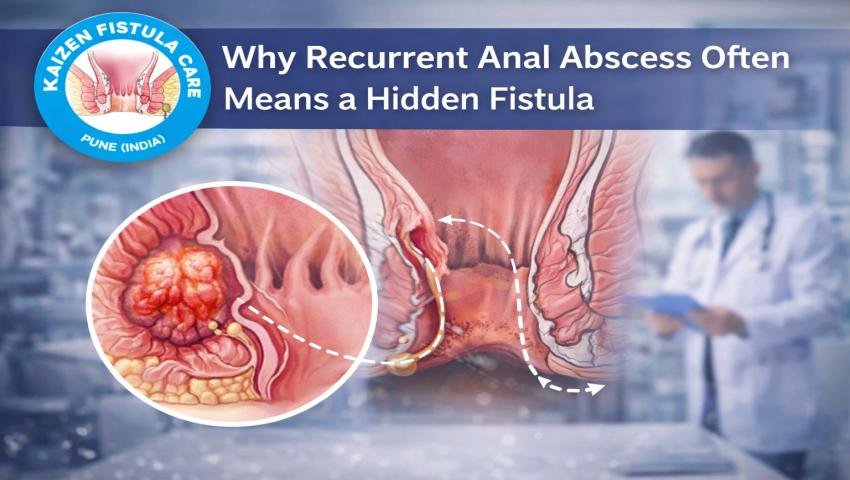
A fistula-in-ano is an abnormal tunnel that connects:

  • The inside of the anal canal
  • To the skin around the anus

The Step-by-Step Process: Abscess to Fistula

  • Infection Starts in Anal Glands: Blocked or infected anal glands lead to pus formation.
  • Abscess Is Drained: Pain reduces temporarily after drainage.
  • Internal Opening Remains: The infected gland inside the anus is still open.
  • A Tract Forms: Over time, a tunnel forms between the gland and the skin.
  • Recurrent Abscess Developed: Pus continues to collect and drain repeatedly.

This cycle will continue until the fistula is treated completely.

Warning Signs That an Abscess Is Actually a Fistula:

You should strongly suspect a hidden fistula if you notice:

  • Abscess coming back at the same location
  • Recurrent swelling near the anus
  • Pus discharge that stops and starts
  • Small opening or pit near the anus
  • Persistent itching or wetness
  • Foul-smelling discharge
  • Pain that improves after pus drains but returns again

According to Dr. Samrat Jankar, these are classic signs of a fistula and need specialist evaluation.

Why Simple Abscess Drainage Is Not Enough?

Abscess drainage treats the collection of pus, but not the cause.

If a fistula is present:

  • Drainage alone gives temporary relief
  • Infection returns again and again
  • Tracts may branch and become complex
  • Surrounding muscles may get involved

Repeated drainage without fistula treatment can make the condition worse.

Why Early Diagnosis Is Critical?

Delayed diagnosis of fistula can lead to:

  • Multiple fistula tracts
  • Horseshoe fistula
  • Involvement of anal sphincter muscles
  • Higher risk of incontinence if surgery is delayed
  • Longer recovery time
  • More complex surgery

This is why early evaluation by a colorectal specialist is essential.

How Dr. Samrat Jankar Treats Fistula After Recurrent Abscess?

Once a fistula is diagnosed, treatment is planned based on:

  • Fistula type (simple or complex)
  • Involvement of sphincter muscles
  • Number of tracts
  • Patient’s bowel control

Advanced Treatment Options at Kaizen Fistula Care:

  • Laser Fistula Surgery (FiLaC)
  • VAAFT (Video-Assisted Anal Fistula Treatment)
  • LIFT Procedure
  • Sphincter-saving surgeries
  • Treatment of abscess + fistula together

The goal is complete cure with preservation of continence.

Why Choose Kaizen Fistula Care, Pune?

Patients trust Kaizen Fistula Care because:

  • Dedicated center only for fistula-in-ano
  • Led by Dr. Samrat Jankar, expert colorectal surgeon
  • Advanced, minimally invasive procedures
  • MRI-guided treatment planning
  • Sphincter-saving techniques
  • Focus on preventing recurrence
  • Management of constipation to avoid re-infection

Patients come from Pune, PCMC, Wakad, Baner, Hinjewadi, Aundh, Nigdi, and nearby areas.

Conclusion:

A recurrent anal abscess is rarely “just an abscess.” In most cases, it is a sign of a hidden fistula-in-ano that needs definitive treatment. Treating only the abscess without addressing the fistula leads to repeated infections and more complex disease. At Kaizen Fistula Care, Dr. Samrat Jankar specialises in identifying and treating fistula at the root cause—ensuring long-term relief and preventing recurrence.